|
Why are deserts so hot?
|
Deserts are hot primarily because of a lack of water. When the sun shines on the
ground, all of the absorbed sunlight goes into raising the ground's temperature. If there was moisture
in the soil, much of this heat would go into evaporation of some
of the water, which requires heat to accomplish, and thus keeping the soil cooler that it would otherwise be.
This cooling is from the "latent" heat of evaporation that is required to change liquid water into
water vapor, and is the same reason why water evaporating from your skin feels cold.
Associated with the lack of water is a lack of vegetation, which would also cause water to evaporate as part of
photosynthesis -- a process called evapotranspiration.
The common perception that deserts are hot because of the bright sand is incorrect. Since vegetation is darker than most desert soils, if a desert
could have vegetation that didn't need water to live, the desert would actually be hotter since it would
absorb more sunlight. Instead, the vegetation causes water to evaporate (and uses some of the sunlight for other plant growth process). Similarly, if deserts were covered by dark soil rather than light soil or sand, they would also be hotter.
|
| Interesting facts:
|
DESERTS ARE COLD AT NIGHT:Because of the lack of water in the ground,
and little water vapor in the air, most deserts can get quite cool at night. This is because (1) dry ground
does not retain as much heat as moist ground, and (2) water vapor
is the most important greenhouse gas, so dry air allows the surface to cool rapidly at night
through loss of infrared radiation to outer space.
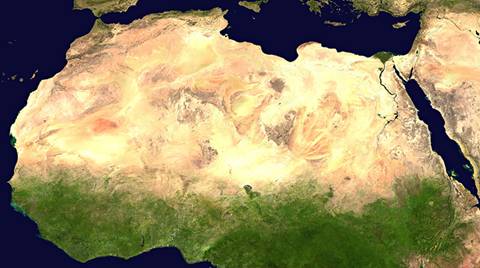
In fact, it has been calculated that the Sahara Desert actually loses more infrared radiation than it gains solar radiation from the sun. This net loss of radiant energy is balanced by the sinking air over the desert, which warms as it is compressed. The air over the desert is, in turn, being forced to sink by rising within rain systems hundreds or thousands of miles away. Thus, in some sense, rain can be considered the cause of deserts(!).
|
|
(page last updated 12/13/2019)
|

