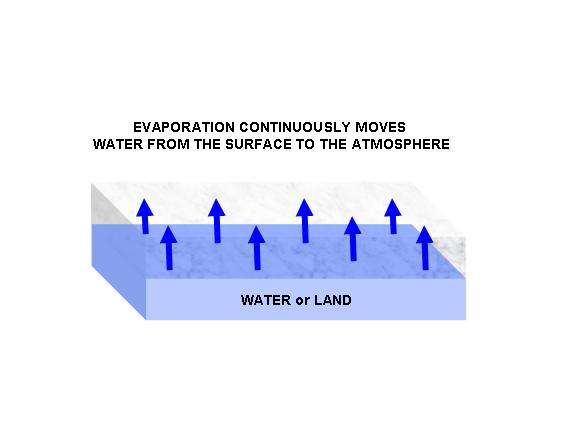
It would be difficult to find a more important process in our weather and climate
system than evaporation. Evaporation is the change of water from a liquid to a gas. Water is
continuously evaporating from the surface of the Earth, literally pumping more and more
water
vapor into the atmosphere.
Averaged across the entire Earth, water evaporates from the surface
at a rate of about 3 millimeters per day (about 1/8 of an inch). Over the tropical oceans, the
value is much larger; over cold surfaces, it is much lower; and over deserts it is almost zero,
since there is little or no water to evaporate.
This change of phase (from a liquid to a gas)
requires heat, called "latent heat". When water evaporates, it removes heat,
lowering the temperature of whatever the water was in contact with. For both water and land surface, most of this
heat energy comes from the surface, not from the air.
Evaporative cooling, along with
convection, helps keeps the surface
of the Earth from getting too hot in the presence of solar heating and the
Earth's natural greenhouse effect.
|