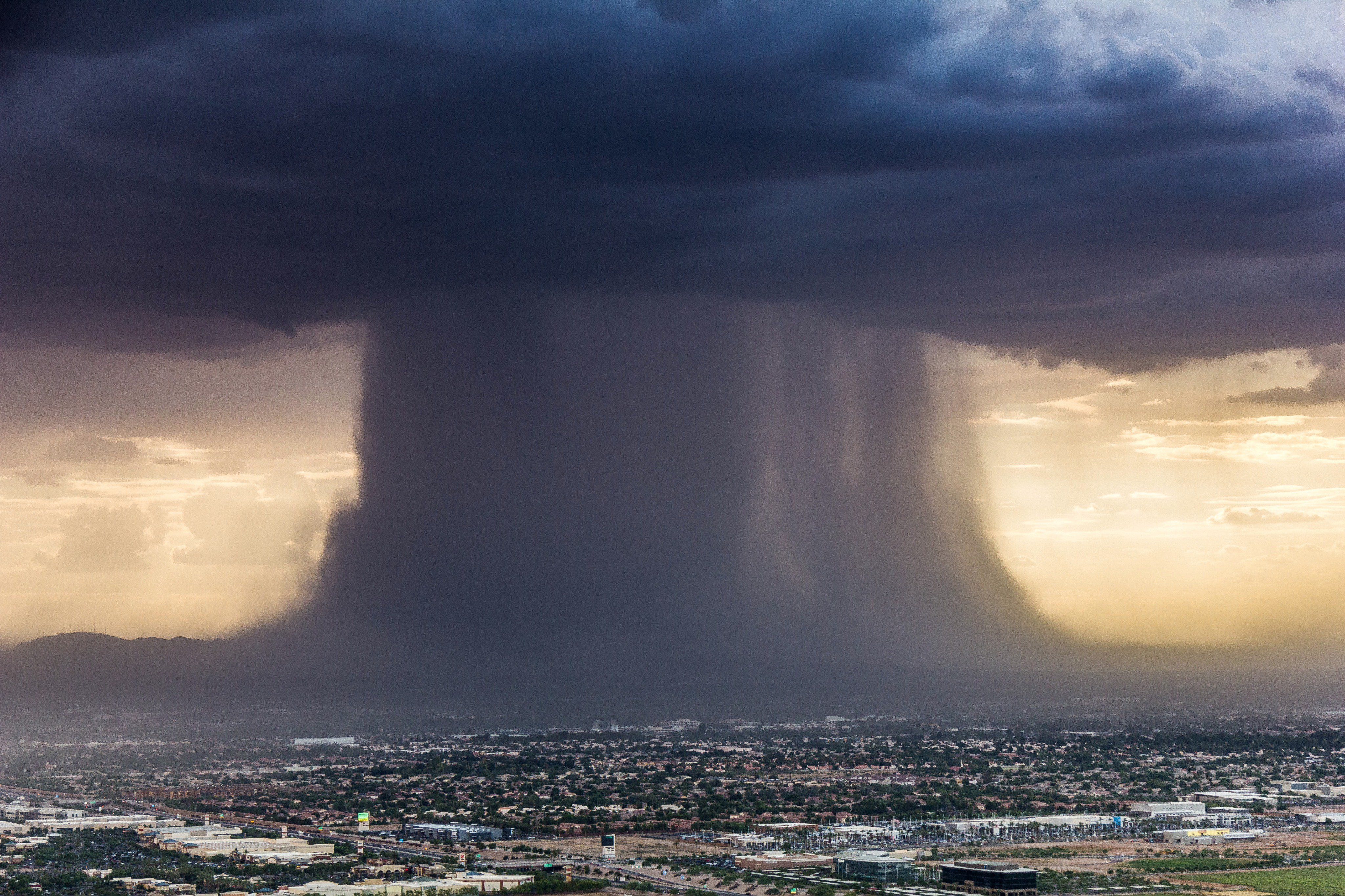
Downburst (or microburst) near Phoenix, AZ (Bruce Haffner/Andrew Park/Jerry Ferguson)
|
What is a downburst / microburst?
|
A downburst is a localized area of damaging winds caused by air rapidly flowing down
and out of a thunderstorm.
To create a downburst at the ground, the downward (downdraft) speeds in
the thunderstorm must be unusually high, and this downward flowing air must penetrate close to the ground.
These conditions can be met when rain falls through an atmospheric layer with relatively low
humidity.
It is not necessary
for the thunderstorm to produce hail or tornadoes to produce a downburst. Damage from
downbursts can be so severe that it is mistaken for tornado damage. When examined, however, the damage pattern from
a downburst will be either straight-line or divergent, indicating the winds were flowing outward, rather than in a circular, converging pattern
as in the case of a tornado. Downburst damage can cover hundreds of square miles, or be limited to a single field (the smallest
ones are called "microbursts").
|
| Interesting facts:
|
|
ONE OF THE WORST: An usually strong and widespread downburst event hit northern Wisconsin
on the 4th of July, 1977, with winds that were estimated to exceed 115 mph, and completely flattening thousands
of acres of forest. More information and
photos of the damage from that event can be seen here.
|
|
(page last updated 12/13/2019)
|

