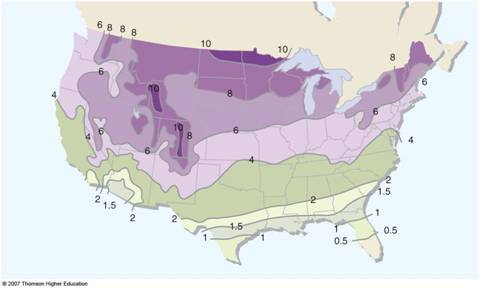
Heating degree days and cooling degree days are a quantative measure of the
heating and cooling needs of buildings based upon daily temperatures.
Both heating and cooling degree days are referenced to 65 degrees F. If the average of
a given day's high and low temperature is 65 degrees, then there are no (zero) heating or cooling
degree days. If the average temperature is 72 degrees F for a given day, then there are (72 minus 65 equals) 7 cooling degree
days. If the average temperature is 50 degrees F., then there are (65 minus 50 equals) 15 heating degree days.
You can add up the
degree days for any time period, say the month of January, and get an idea of how much heating was
required to heat buildings. The graphic seen above shows an estimate of the average heating degree days (in thousands)
over the course of an average year.
The energy industry pays attention to heating and cooling degree days
as a way to easily and quickly estimate energy usage, which then helps to help predict energy prices.
|