How do clouds form?
|
Clouds are possibly the most interesting -- and beautiful -- of all weather phenomena.
While there are a wide variety of cloud shapes and sizes, they are all made of the same thing:
condensed water or ice. Clouds form when rising air, through expansion, cools to the point
where some of the water vapor molecules "clump together" faster
than they are torn apart by their thermal energy. Some of that (invisible)
water vapor condenses
to form (visible) cloud droplets or ice crystals.
The cloud example pictured above is considered "convective", because it is produced from
warm air pockets rising directly
("convecting") from the underlying surface. Convective clouds are typically smaller,
a hundred yards to several
miles across.
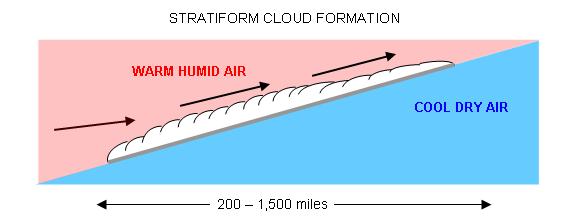
"Stratiform" clouds, in contrast, typically cover much larger areas
and are caused by much broader layers of more slowly rising air (see below), often associated with
extratropical cyclone activity.
Stratiform clouds have a more uniform, featureless
appearance, and often cover the whole sky.
|
 |
Some different types of clouds can be seen here.
After cloud droplets (or ice crystals) form, then what happens to them? One of two things. Either they
collide with each other and grow by joining together to such a large size that they fall to
the ground as rain or snow, or they evaporate and change back into water vapor. It is estimated
that, on average, about one-half of all cloud material in precipitation systems eventually falls to the Earth as precipitation, while the
other half re-evaporates back into water vapor.
|
| Interesting facts:
|
| DROP SIZE AND CLOUD APPEARANCE The smaller the drops in a cloud
the brighter the tops appear (and the darker the bases). Smaller droplets scatter more sunlight, while large
drops allow more sunlight to pass through. This explains why the heavily raining part of a shower cloud
or thunderstorm is usually brighter than just the cloudy part. The cloud droplets have combined into
large raindrops, which allow more sunlight to pass through them.
|
|
(page last updated 12/13/2019)
|

